
I did something I haven’t done in years a few weekends ago. Taught a Self Defence course. These were all the rage “back in the day”, by which I mean 20 or so years ago. I can’t remember why but a bunch of us were drafted into helping out and I have distinct memories of being used as fodder for enthusiastic participants to push around, try choke holds and arm locks and basically get stuck in. Back then there was no health and safety really, lets face it, this was Ireland and we were in a community centre with no heating and barely any door I don’t think I ever saw a first aid kit either. Running as part of a night course I scampered across town put a suit on and tried to look like I knew what I was doing. The following day having to explain the bruises on arms, legs and neck from an over enthusiastic student.
A lot has changed since then, but somethings remain the same, unfortunately the news is full of incidents of violence against ordinary folk going around their daily lives. Now here’s my first big statement. I don’t personally believe that you can teach someone to be able to defend themselves over the course of a few weeks if the attack becomes a serious trade of blows. For sure we can teach a level of Zanchin (残心), or awareness, and in fact that might be all that’s really required, but unless you are going into high stress situations at least once a month you will have little or no way of knowing how you will react in a violent situation. I’m not talking about teaching how to break a hold or restraint here, I’m talking, things have gone very wrong and now it’s a proper fight.
What do I mean? Many of us will know the phrase “fight or flight”, what you might not be aware of is that this was developed by Walter Cannon in 1929, his theory relating to animal response to a perceived threat. Since then, knowledge of this area has developed, we see additional elements and understanding coming from the likes of Jeffrey Gray (1988) who investigated the different states of fear.
We should really take a second to define some terms here. Fear is a reaction to something close by that is understood to threaten ones safety. When we go a step further, the emotion of fear is really things like dread or foreboding, like the feeling you get looking down a dark alley with known dangers. Therefore, the idea of “fight or flight” is a fear response.
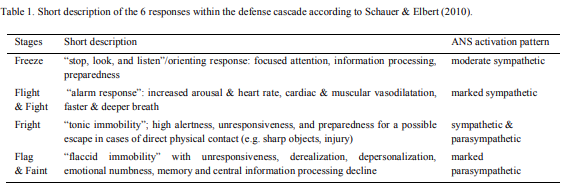
I did say that this area has developed though didn’t I, there is a huge body of work in this area which I won’t even attempt to summarise, however, the table below is a good example of where the thinking has evolved. Below you will see that we have events that occur when faced with a threat. In fact, Schauer and Elbert (2010) found that this series of events can occur in a cascade manner, the sympathetic arousal reaching a maximum at the fright stage, and is eventually replaced by the onset of dissociative ‘‘shut-down’’. OK so yes that did sound a bit psychobabbly but the table below should make it fairly straightforward.
Anyone who has done martial arts for a while will know that friends and relatives often have this romantic notion of what a blackbelt should be able to do in a confrontational situation. Most martial artists know that the truth is very much further from the flying images of Jackie Chan esque kicks. Thankfully most of us (martial artists that is) have never had to “test” our “skills” in a real situation. Now, huge disclaimer here, I’m not suggesting that we head out en-mass and pick a fight with some poor unsuspecting. However, over the years, when I have asked individual how they might react under pressure, most, understandably don’t know. Most have in fact never put their technique under pressure.
So how do you do that?
This is the hardest bit, let me tell a story. Over the years Thursday night has become “fight night” in our dojo. By far the hardest class and most physical and yup, you guessed it, the least well attended. Now the truth of the matter is that we don’t kick lumps out of each other, but if you ever wanted to know how your technique is doing it’s the class to do go. Now don’t get me wrong, I’ve nothing against folks training away on kihon and kata, but after many years specialising as a fighter, I’ve never been hit by a kata. I joke, but these won’t make you a fighter, fighting regularly will, preparing for these conditions will and taking those lovely techniques from kihon and putting them under pressure will. But maybe not on the street. In the dojo we set boundaries as to what is acceptable and safe, and rightly so. We are in a well lit area with plenty of open space around us, oh and we are dressed appropriately. Our “attackers” are, well, choreographed. I genuinely don’t care who I stand in front of, if they hit me, good on them, I didn’t block, simple. If you stand in front of me, please continue to do the same, go for it!
The closest we have to this notion of putting your technique under pressure is all out dojo sparring or competition. I don’t know how many times I’ve walked off the mat thinking, “what happened there?”, was I asleep or what? My biggest issue used to be, “losing the head”, where my fight instinct kicked in and I forgot all the rules, usually resulting in a disqualification. Now don’t get me wrong, I’m not saying that we should throw everyone into mad dojo sparring, in fact that’s the worst thing you could do. I’ve written an article somewhere about the fact that whilst we layer experience in kata, we rarely do the same in kumite. I’ve only seen this done well a few times. The result, those who get spooked, are less likely to return to kumite classes or they tense up during dojo sparring and either 1) hurt themselves or 2) hurt others.
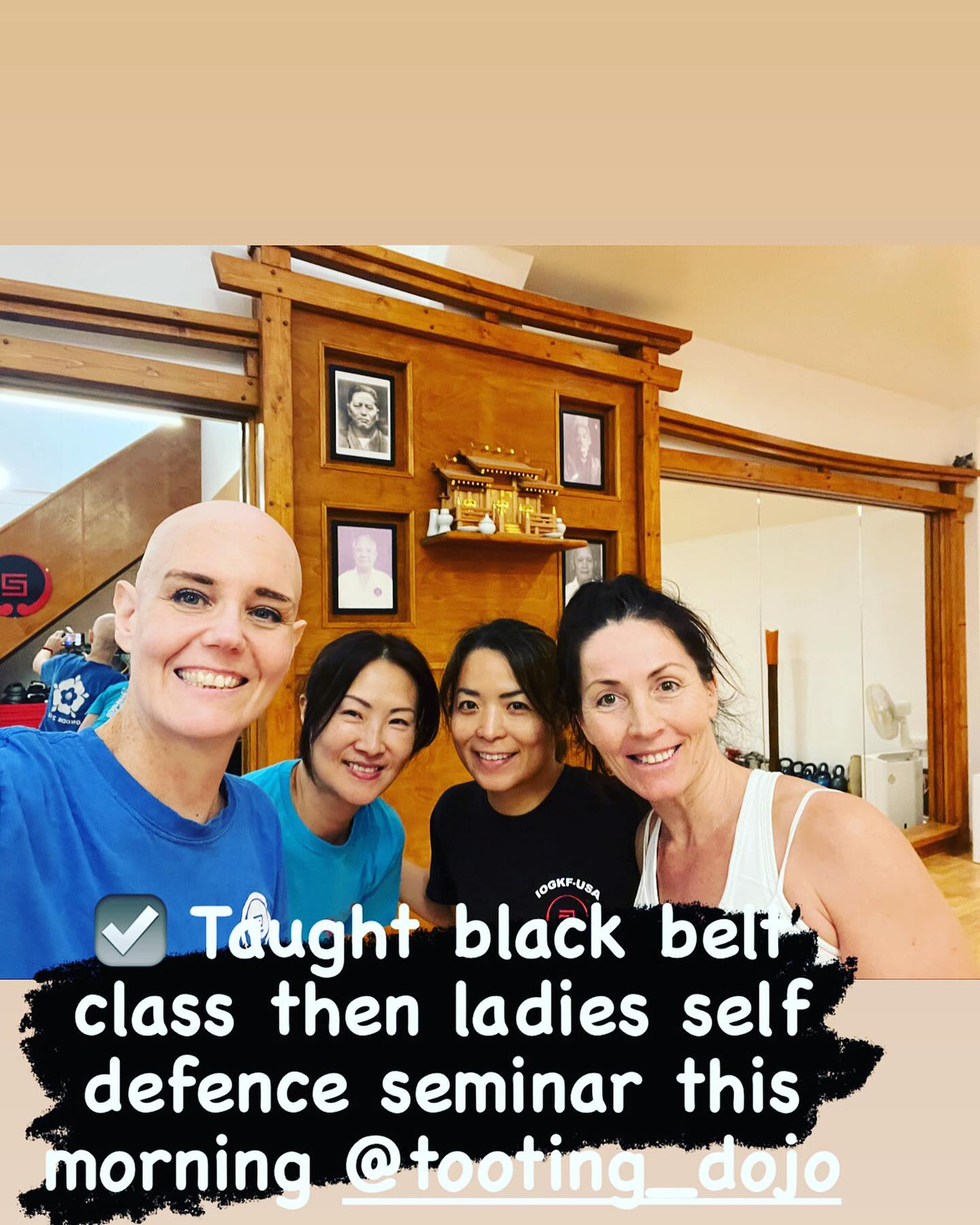
What was very interesting to see as I taught this class was the fact that some of these women (it was a women’s self defence course) actually had the answers to a lot of the situational questions I asked. Why, because they needed them and have developed their own Zanchin over years of self preservation. Self defence is as much about common sense, don’t walk down dark streets in between a van and a wall for example, as much as it is about psychology, walk tall etc.
For sure self defence classes will build self and environmental awareness when the subject is introduced in a considered manner. It was also quite interesting to see some of our blackbelts realise that actually, untrained individuals could be extremely strong and they learned quickly! Self defence is not a one and done scenario and we were at pains during the course to point this out, that in reality, folks would need to keep working on the skills they were learning. I also had a myriad of caveats. But all that said, I can only hope that there may well be some take away that will keep them safe. News reached us that one of our attendees at the course was able to break from a hold by a man at the weekend in a London pub a strange thing to be happy about, but these are the times.
It would be great to think that tomorrow will be the day when no matter who you are, introvert, extravert, tall, small, male, female etc etc you could walk the streets safely, until then, we need to continue to learn how to protect ourselves and our loved ones should we need. Until then, the training continues and the search to put my technique under the sort of pressure it’s likely to find should I need to use it…eek!
References
B. Cannon, W. (1929). ORGANIZATION FOR PHYSIOLOGICAL HOMEOSTASIS. PHYSIOLOGICAL REVIEWS, IX(3).
Gray, J. A. (1988). The psychology of fear and stress. Choice Reviews Online, 26(04), 26–2399. https://doi.org/10.5860/choice.26-2399
Schauer, M., & Elbert, T. (2010). Dissociation following traumatic stress. Zeitschrift Für Psychologie Mit Zeitschrift Für Angewandte Psychologie, 218(2), 109–127. https://doi.org/10.1027/0044-3409/a000018
 KiyoCiara