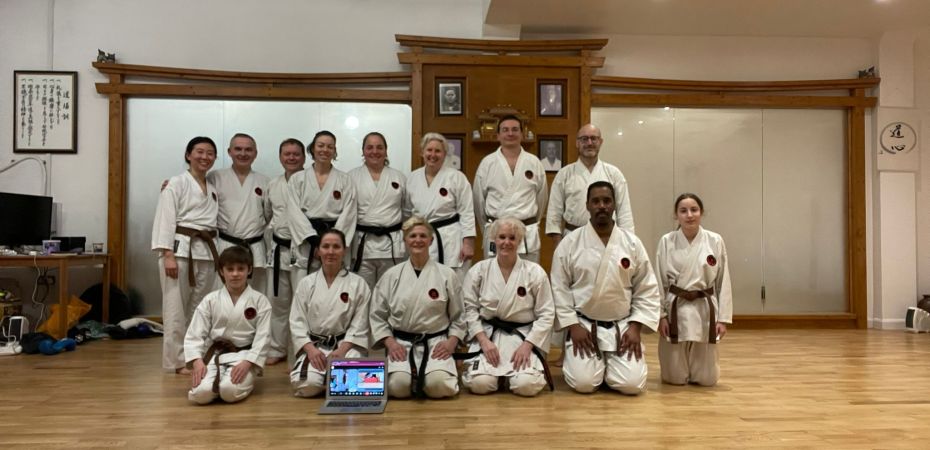
When I wrote about the nerves before the gasshuku, I didn’t yet know how the weekend would unfold. I only knew that it mattered.
For context, I was teaching a kumite-focused Gasshuku with Sensei Linda Marchant. I enjoy kumite deeply, but I’m also very aware that for many people it’s the point where tension, anticipation, and uncertainty tend to spike. My interest lies in addressing that — not by diluting kumite, but by bringing structure and tools that folk can take away and work on and hopefully become more comfortable.
Looking back now, I can say the nerves were appropriate. They kept me attentive. They kept me honest.
Friday: Establishing Control Variables
Friday was a black belt session, and we began by reducing variables.
Sensei Linda got the gasshuku underway with Sanchin, used as a reference point — not as a performance kata, but as a diagnostic framework. The goal was to feel how structure behaves under pressure: alignment without rigidity, tension without collapse, and the relationship between breath and intent.
Rather than starting with combinations or free exchange, I then focused on the underlying mechanics that make kumite functional: posture, distance management, breath control, and intent. Which really means we used a few techniques over and over.
From there, we examined kumite techniques in isolation. Attention was placed on how punches differed in transmission of force, how posture either supported or disrupted kime, and where extraneous movement was creeping in. Having established Sanchin principles, it became immediately obvious when kime degraded under repeated, fast execution. For many, this highlighted the gap between technical understanding and technical delivery under stress.
Progress was deliberately slow. Precision mattered and then we worked in pairs and put those techniques to the test, happily no one went home with teeth in a box.
Reaction and timing were then explored using simple external stimuli (tennis balls). This stripped away pre-planned responses and exposed flinch patterns, delayed initiation, and excessive muscular tension — all of which directly translate into kumite inefficiency. This is a really fancy way of saying that all hell broke lose and there was laughter, and balls going everywhere!
Saturday: Fatigue as a Technical Tool
Saturday morning brought a full dojo!!
After Sensei Linda’s session, I introduced targeted fatigue work focused on the shoulders and arms. This was done with a specific technical aim: to remove reliance on gross muscular effort. When the prime movers are fatigued, the body is forced to reorganise. Excess tension becomes unsustainable, and technique either becomes more efficient — or fails outright.
This set the conditions for more honest movement.
From there, we worked on kumite that prioritised accuracy, spatial awareness, and partner management. Rather than pursuing complexity, the emphasis was on maintaining structure while adapting to a live partner. Kumite was framed as an exchange of information — reading intention, managing distance, and responding appropriately rather than imposing predetermined solutions.
We integrated Jiu-Ippon Kumite with O-waza and Ko-waza to explore the transition from fixed structure to adaptive response. This allowed people to test how well their fundamentals held up once variables were reintroduced. Importantly, the environment supported experimentation: failure was expected, adjustments were encouraged, and learning was continuous.
Sunday: Conditioning, Integration, and Randori
Sunday began with functional conditioning, focusing on how strength and fitness can support kumite rather than interfere with it. The emphasis was on resilience, repeatability, and movement quality — training that allows technique to remain available under fatigue. Before training, I packed the car with all my kit, in truth, I wouldn’t use all these pieces but I wanted to share the wide range of ways in which kumite elements can be enhanced. Once set up, we had circuit that also included pair work, short sharp sessions on a station then into kumite. I felt the effects for days.
We concluded with randori.
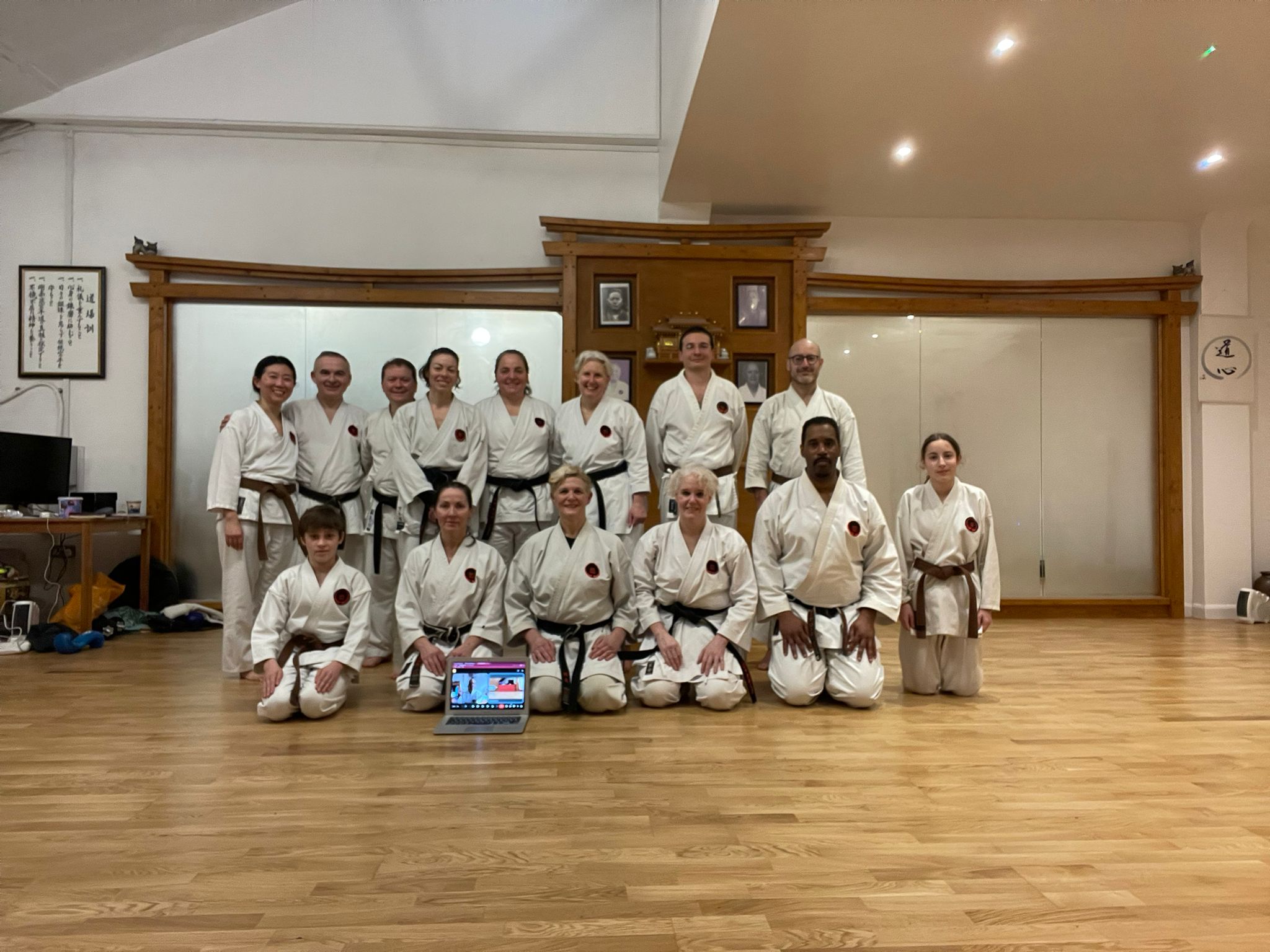
What stood out was the technical consistency. Despite fatigue, everyone was laughing, full of energy and most importantly, maintained engagement, control, and respect for their partners.
On the Other Side of the Nerves
In hindsight, the nerves didn’t disappear over the weekend — they sharpened my attention. I was planning and replanning my sessions through the weekend, feeding off the points that Sensei Linda brought up and trying to make everything relevant and accessible.
All of which, reinforced the responsibility (I felt) that comes with teaching kumite: not to impress, but to create conditions where people can safely experience pressure, uncertainty, and adaptation. When those conditions are right, confidence emerges naturally — grounded in structure rather than bravado.
I’m deeply grateful to Sensei Linda and to everyone who stepped onto the floor with openness and intent. Opportunities to explore the technical development of kumite at this depth are rare, and I valued every moment and the chance to share my teaching methods and technical viewpoint.
The nerves were justified.
They kept the work honest.
My only regret, we went for lunch at a regular pub hangout and I had it in my mind from Sunday morning, session 1. I was having the pie. Ox Cheek Pie, Creamy mash, tender stem greens, a staple from their menu. The last one, sold to the person just before me. Ah well.
 KiyoCiara